Saturday, October 17, 2020

Streets 3 - Configure


Photo of a street; caption "3"
< Back | Forward >

Let me say some obvious things about streets.

A street has direction. It leads from one place to another. It leads from the same place today as it did yesterday, and to the same place today as yesterday. Where our streets are built—where they start and where they lead—reflect our community’s historical priorities, which we have inherited, regarding which places are important for people to be able to easily travel, and which are not.

If a street isn’t maintained, it will fall into disrepair. If the disrepair isn’t remedied, it will get worse, not better. A city that won’t maintain its streets will eventually become a city incapable of creating or receiving the value of transportation. So: we maintain our streets, if we’re wise. And so, simply by observing the conditions of our streets, we can make determinations about our community’s current priorities; not just which places are important for people to be able to access, but which places are more important.

And, which are less important.

If we want to make the street longer, we can extend it, but it will still lead out further in the same direction. If we were to decide that where the street led wasn’t a useful destination any longer, or if we realized the destination was harmful, or if for some other reason we wanted it to no longer lead to the destination it did, but to some other place, we’d need to greatly modify the street we had, to the point that it would begin to seem like a different street entirely.

If we wanted to allow easy access to some new location that had as yet been afforded no street, we’d need to build an entirely new street. A casual observer would easily be able to detect the new priority within our community. A place that had not previously been important to access has now become important. There is a new airport on the outskirts. A road has been built to the airport. The airport is important. If no road were built to the airport, the airport would be a boondoggle.

If we no longer cared about a location that we previously deemed important, we might stop maintaining the street, and allow it to fall into disrepair. A casual observer would easily be able to detect the underlying truth about priority; about a place the community once valued, which it values no longer—and, if there are people still living on that street, about those people, too.

And the people living there would also understand, of course. They, too, would understand at a glance what message was being delivered through their neglected and decaying street.

You might say that our streets are a tool—one of many—whereby a community delivers its priorities—its real priorities. The ones that can’t be denied, because they are what’s being done.

A rundown street.
Photo credit: Tamar Charney

And, if we were to chart the full history of changes to our streets—of enhancement; creation, modifications, construction; and also of neglect, removal, and demolition, too—we could conceivably create a map of our community’s historical and ongoing priorities regarding human access.

So, our streets are configurations of our community. They, like all human systems, are changeable. Configurable. They will deliver the more core and underlying priorities of the part of the community that has power to decide on priorities. That’s the human part of the system.

Let me say some obvious things about configuration to human systems, once again using streets as illustration.

If we wish to maintain our streets, or extend them, or modify them, or build new ones to serve new needs, we would have to … do it.

But some time before we do it, we’ll have to realize that there’s a need to do it.

And some time after that, but still before we do it, we’ll have to accept that doing it is our collective responsibility.

And some time after that, but still before we do it, we’ll have to determine to actually do it, and make the necessary plans.

And some time after that, but still before we do it, we’ll have to agree to pay what it costs.

And some time after that, the cost will actually have to be paid.

And only once all those steps have taken place will the street actually be changed or maintained.

If these steps don’t take place, then the change won’t happen. The street will remain as it is.

Streets are configurable. People made them. People can change them.

We can set them upon a foundation that is even, or uneven.

We can use materials that are sturdy, or shoddy.

If they’re uneven or shoddy, we can make them better.

Or … we can make them worse.

We can configure them to generate opportunity and value and health equally for all. Or we can configure them to steal opportunity and value and health from some and give to ourselves.

This configuration will reflect our community’s priorities—the real priorities.

And the natural qualities of a natural human system mean that the theft and harm will be delivered to those it victimizes in the same way that the opportunity and health is delivered to those it favors: in a way that is shared, invisible, foundational, generative, automatic and inextricable.

That's the natural part of the system.

As I said: obvious.

I think these are very plain and obvious things to say. I’ve learned that this is an age in which it has become useful and necessary, even powerful, to state plain and obvious things.

____

Let me say some obvious things about human priorities: They tend to have a momentum. They act upon reality, and create effects. Those effects bend reality toward that priority, making reality more aligned with that priority, making it easier for that priority to further bend reality toward itself. They lead from one place to another. And so, like the streets, human priorities, too, have direction.

A priority, unchecked, increases its effects. Left entirely unchecked, it will eventually reach a state in which the priority’s intention is indivisible from reality itself. So, a priority based upon a desire for a sustainable system will allow itself to be checked toward sustainability, while a priority based upon an unsustainable lie will eventually check itself toward unsustainability; will inevitably destroy that system itself in favor of itself.

You might think of a priority based on a lie as a virus. A thing that exists only to promote itself, which has no place whatsoever within a healthy system, which will eventually consume that system if left unchecked.

Imagine the most extreme example: a system so unfair that every bit of value my street generates—every wage, every increase to property, every bit of food, permission to drive on the street or walk on the sidewalk, permission to access the homes for living or storage—goes only to me, and to me alone. The only result can be that eventually my neighbors are crushed, leaving me alone, receiving only the value I can deliver to myself, for however long that lasts.

In time, I would become a bizarre and unsustainable curiosity. Having cut every other human out of my natural human system, I have made an unnatural human system; a system that no longer generates the value that a community of humans naturally makes. Eventually I, too, will fail—not despite the fact that I have all the wealth, but because.

If I live in a system that eats my neighbors, I live in a system that will eat me in the end—even if I'm the one the system feeds.

An unjust system is an unnatural system.

An unnatural system is an unsustainable system.

And the defining quality of an unsustainable system is, it doesn’t sustain.

____

Think of a recent picture I’ve provided. Think of the rain, a natural occurrence, necessary for life, which my house receives invisibly, automatically.

Imagine something: Imagine a city where a few people decided to capture the rain. Imagine they built a series of gutters and downspouts and barrels and cisterns, so that when the rain fell on all the houses, they could divert most of it away from some of the people and bestow it to a select few others. Imagine a city comprised of islands of perfect lush green, swimming in a vast sea of blasted and parched and unnatural desert. Imagine a city that manufactured drought during a rainy season, then horded water, unused, in times of drought.

Or, less metaphorically: imagine a city that recognized the intrinsic value that a collection of people naturally generates—inextricable, automatic, inherited, shared, invisible—and decided to configure it to capture all that value for themselves.

Imagine, if you can, a society founded on a series of unjust lies—a series of propositions which, like a virus, have no place in a healthy society; which, like a cancer, grow out of systems that would otherwise be necessary for health; and which, like both virus and cancer, exist only to propagate themselves at the expense of health until those systems were consumed.

Suppose the founders of this society had learned that they could maximize the foundational, generative value that is the natural output of human society, by stealing all value away from millions of other humans, and giving it all to themselves. Suppose they did this by utilizing the idea that it was not only possible but desirable, not only desirable but righteous, for human beings to own other human beings as possessions. Suppose they founded their society on the proposition that the Owners should be the only people within the society allowed to partake in the collective will of the natural human system they’d built, and to control all the value delivered, and to parcel value out to the Owned only to the exact extent to which such an allowance would profit the Owner.

I would suppose that such a society would begin to believe, at the very core, that some people have value and others do not.

I would suppose that such a society would conclude that a person’s value is a matter of power and wealth, and to lack power and wealth is to lack any value.

I would suppose that such a society would conclude that for those who lack value, life must be earned by providing profit.

I would suppose that such a society would conclude that for a valueless person to receive some value beyond the profit they could provide would be a grotesque and offensive theft; that a person who could not be used for profit had not earned life, represented theft, and had therefore earned death.

I would suppose that such a society would believe violence to be an acceptable way to redeem such a debt against such a valueless thief.
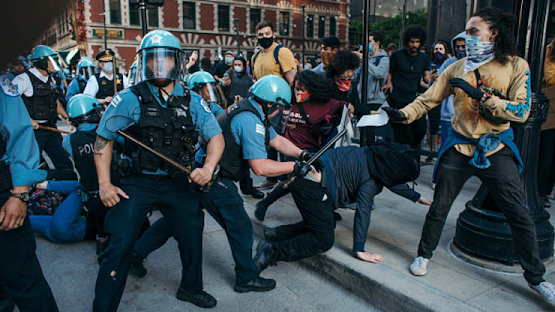
Photo of police rioting violently against people protesting the police murder of George Floyd.
Photo credit: Jim Vondruska


If my theories are correct, such a malicious idea would do what unjust lies always do: it would collapse the system. It would make institutions that in a healthy system would be vital to continued health into something grotesque and malicious; would make these institutions susceptible to practices, ideas, and intentions that have no place in healthy society. Eventually these foundational injustices, built on foundational lies, would devolve into unrest and internal war until either they captured the system entirely, or else they were defeated.

A society founded on many such lies would likely face a series of such collapses.
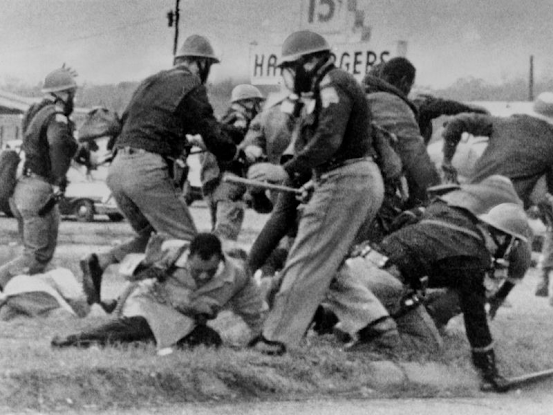
An Alabama State Trooper swings his baton at the head of the then-25-year-old Congressman John Lewis on March 7, 1965. ( Everett Collection Historical, Alamy Stock Photo)


For example: such a society might find itself into an observable historical cycle, whereby all resources and power would become unnaturally allocated with fewer and fewer people, until most people struggled to find what they needed to survive even though plenty existed all around, and found themselves with less and less recourse to effect any change, while a very few ruthless people managed to capture for themselves more resources than they could ever possibly use, which they would credit to themselves as proof of their right to own it.

Ku Klux Klan parade in DC in 1927 (GETTY IMAGES)

If such a society managed, through some combination of luck or effort to push back these unsustainable scenarios, it would be necessary for them to engage in the same practices any survivor of cancer or virus finds it necessary to engage in, if they were aligned with ongoing health. There would need to be a diagnosis— acknowledgement that the unjust lies and their unjust practices existed; then there would need to be a short-term change—radical, targeted, painful—to eliminate the threat; then a long-term remedy—a permanent, holistic, watchful, strategic, systemic restructuring—to monitor for and prevent recurrence.

But if they refused?

If they did that … then, if my theories are correct, you would inevitably see the healthy systems compromised and captured by the same old foundational lies, until everywhere you looked you would see the terrible old assumptions: that some people have value but most do not, that wealth is the measure of value, that the valueless must earn life through profit, that being unprofitable earns death, and that violence redeems.

A woodcut from the abolitionist Anti-Slavery Almanac (1839) depicts the capture of a fugitive slave by a slave patrol.


And such a system would inevitably begin to collapse.

Can you imagine it?

As a novelist, I might be able to manage such a thought experiment.

Let’s see … what would it look like?

____


Imagine a fictional city. Let’s call it something random, like, oh … Randopolis, in the land of Galtopia.

Let’s say Randopolis was the sort of place built on the sort of foundational lies I’ve just described.

Imagine they believed the lie, that some people had value and some didn’t.

Imagine they believed the lie, which attributed worth to wealth.

Imagine they believed the lie, that for anyone without wealth to receive any value equaled theft.

Imagine they believed the lie, that violence redeems.

And imagine that these people believed these lies to such an entrenched state that when they founded their city they owned other human beings as property.

Imagine a city like Randopolis, that had captured the natural human systems of society; had harnessed the mechanisms by which humans provide value to one another, and subverted it to unnatural ends, to instead deliver harm and theft to many for the enrichment of themselves.

To assist our world-building efforts, we might give this subversion a name, like injustice.

Imagine the more powerful members of Randopolis decided to optimize for injustice—to purposefully engineer the mechanisms by which cities decide things, so that when the city decided things, certain types of people were much more likely to be included in making those decisions, and all others were much less likely, so that the concept “the city decides” inevitably meant, in ways both visible and invisible, only a select type of people. Let’s say, for argument’s sake, that the favored people resembled the historical Owners: mostly older, mostly whiter, mostly wealthy, mostly male. Imagine that this happened to such an extent that it became an assumed thing, to the point that whiteness and wealth and age and maleness became the default assumption for decision-making in Randopolis, even an automatic and invisible assumption, a comforting thing, and anything breaking this mold was seen as a break from precedent, a special case, a risk—identity politics. In fact, for the first let’s-say 150 years of Randopolis’ let’s-say 250 year history, this restriction was not just an assumed preference, but codified as law.

Imagine the underlying configuration of such a foundation.

Imagine the ongoing inheritance of such a configuration.

Imagine now that because Randopolis had decided, over the course of generations, to route the value that a collection of people naturally generates, so that some received most of it while others received less, it so happened that no matter what sorts of remedies they put in place to configure against these unjust effects, the effects would inevitably come through, because the deeper intentions of Randopolis had never changed—the deeper intentions, the ones that matter, because they reflect what actually happens. These intentions came through because human intentions have a certain momentum. The effects of Randopolis’ founding lies always told the tale, not because those making the decisions always consciously believed those who the system robbed deserved to receive less (though they often did believe that), or because those making the decisions always consciously decided they’d rather keep more for themselves (though often they did so decide) but because the deepest intentions of Randopolis had become inseparable from reality in ways that were invisible and inextricable.

Imagine if for decades, people who had been stolen from in this way inherited that loss. Imagine they were systemically and not-so-secretly considered, simply by their existence, to be considered not victims of theft, but to be loss of value itself, to the point that houses were perceived to lose value simply by having such a person live within it, or even in proximity to it.

Imagine if that perception became so powerful that people treated it as reality. Imagine that those who had inherited all the stolen value used the fear of loss of value to remove all their stolen wealth elsewhere, to avoid sharing it with those they perceived as representing that loss—and so more value was withdrawn. Imagine that when this withdrawal applied to certain functions that are essential to a sustainable society—like for example schools—it was framed as choice, and notice how the framing conveys an assumption about who is permitted to choose.

Imagine if the people who were perceived as loss of value had once upon a time been the slaves that had built the older foundational roads, whose value the rest all inherited. Imagine if they were allowed to be perceived as loss of value because their ancestors had once been property, and, having repatriated their selves back to themselves, had stopped being property. Imagine that by no longer being property their former owners decided their very bodies represented not freedom for the freed, but theft from the owners.

Imagine if, in Randopolis, when people talked about the manumission of enslaved people, they said things like “we freed the slaves,” as if freedom itself were a gift that had been bestowed by Owners to Owned, rather than a natural right unnaturally stolen and rightfully returned.

But let’s go back further. Let’s imagine that this example of theft of value and displacement wasn’t just a single event, but a cycle. A foundational pattern. An intrinsic cultural methodology, to be found, once one had eyes to see it, everywhere; quite literally, everywhere. Imagine if the land upon which the houses and streets of Randopolis had been built by enslaved people had been stolen from somebody else entirely, and the people who lived there previously had been send off to live elsewhere. 

Imagine if that value, which had once belonged entirely to them, no longer did, and, it seems, never would again? Imagine a theft so total as that.

In Randopolis, these were assumptions so rooted in the public consciousness of those who benefitted from it, so buried beneath the soil, that they were entirely invisible to their consciences, even as they picked and ate the fruit of those unnatural roots. Imagine if all of this was, to those who never suffered the consequences of these decisions, but who mainly reaped the benefits, largely invisible, and automatic, and inextricable, and shared, and inherited.

And because injustice inevitably occurred in their society, the citizens of Randopolis began to conclude, that injustice was an inevitable reality, rather than to suspect that they were foundationally unjust.

You’d be able to see this sort of dynamic play out wherever you looked, literally anywhere—in Randopolis, remember—the fictional city I’m asking you to imagine.

Watch:

Imagine if in Randopolis the city decided at some point to build its streets primarily to convey cars. Imagine the city decided to put only cursory thought into the fact that some people possess insufficient wealth to own a car. Imagine that a city did this, until Randopolis became a much more difficult and expensive place to live if you didn’t have a car than if you did. Where not being able to afford a car made it less likely you’d be able to afford one in the future, either.

Imagine if some of the people involved in making such decisions owned car companies, or companies supporting or fueling the automobile industry, or owned large interests in such companies, or were friends with people with such interests. Imagine if most of the rest received generous payments from such companies to assist them in holding their plum positions.

Imagine something more: Imagine the streets in Randopolis were built in such a way as to cut some people in the city off from easy access to the rest of the city. Imagine if streets in those parts of the city were not maintained. Imagine if the city decided to do this.

Imagine if the city decided to divert less of its investment to those cut-off streets than others, year after year, decade after decade, until one could easily perceive which streets Randopolis had deemed worthy of investment and which it did not, and, by inference, the people living on those streets.

Imagine if the city decided to send municipal forces down only some streets to enforce laws, but not others, year after year, decade after decade. Imagine they were sent down streets that were presumed theft, presumed threat, presumed poverty, to secure “safety” for streets that were presumed safeness, wholeness, wealth. Imagine that over the years these forces were more and more equipped like military, like soldiers. Now imagine that the effect of all this policing was that the people who were perceived as presumed theft were charged with far more crime than any other, and as a result they also became presumed danger.

And so, the people who had inherited the injustice of theft also inherited even the culpability for the crimes committed against them, which was used as license for further theft. In Randopolis.

Imagine if year after year, decade after decade, the people living in houses on those streets had the shared, intrinsic, inextricable, inherited value of those streets deliberately diverted away from their street, and into all the other streets.

Imagine if for decades (in Randopolis), the city decided to help certain types of people own houses, while at the same time the city decided to not help other types of people own houses, or even to make it much more difficult, or impossible. Imagine after time those who had received this assistance were able to leverage the value they’d gained from having their houses to actually be able to buy other houses, which they would then rent to those who hadn’t been given the opportunity to create such value. Imagine if the city decided that these rented houses only needed to have as much value put into them as the owners decided they wanted to put. Imagine that, in Randopolis, a system was invented by which those who sold houses all tacitly agreed not to sell property in areas that had received stolen value to certain people who everyone tacitly agreed represented loss of value. 

Imagine it were easy to do so, because those who lived on streets with stolen value all just so happened to have darker skin. Strangely, even though the neighborhoods whose value had been stolen contained mostly people with darker skin, no individual person with lighter skin could remember ever discriminating against any person with darker skin. Somehow it was just something the city decided, without deciding to, with no intention. Almost as if it had happened invisibly, automatically, inextricably.

And imagine then, that those in Randopolis who had inherited the benefits of all this diverted value were able to leverage that stolen value against the lessened value of the plundered areas, to purchase those areas at a discount, as an investment, then realize fantastic profits, as the presence of the assumed value of their selves, who had inherited a deliberate disproportionate value, replaced the assumed loss of value of those who had inherited a deliberate disproportionate loss, and so the city decided to once again invest in the maintenance of the streets, to allow value to flow once again into a place that had for decades seen the natural flow of value deliberately cut off.

Imagine some of the older streets, paved new, covering over the older roads, built on land stolen by others, constructed by child labor, underpaid labor, or by slave labor, allowed to fall into disrepair, until people perceived valuable arrived to bestow their assumed value upon them.

Imagine the collective weight of all that unnaturally diverted and stolen value. Think of the centuries of theft. Think of the centuries of inheritance—because natural human systems are inherited. As with the benefit, so with the harm.

Imagine a land optimized for injustice, as it slid into complete injustice.

Imagine a land where only a few people held almost all the value and influence the society provided.

Imagine a land where they used that value and influence mostly to try to get the rest.

Imagine a land that had become an unnatural human system optimized for injustice.

Imagine a land built on a bad foundation, as it began to collapse.

Imagine Randopolis.

Atlas Shrugged movie photo; mausoleum engraved "'I swear by my life and my love of it that I will never live for the sake of another man, nor ask another man to live for mine"
Imagine millions of people believed they could actually live by this maxim.

____

A hypothetical: say we discovered that the streets were discovered to be the cause of 95% of all cases of cancer. What if the very composition of our streets was discovered to contain some substance, which over time had become radioactive. Suppose they had made our streets so radioactive that they were causing active fatal harm to the people who used them. An asbestos of transportation, let’s say. What then?

Well, then: we’d need to replace all the streets. How many? All of them. How far? To the very boundaries of the city. Or we’d have to accept that the streets would kill us.

It would be the same steps for a larger modification as for a smaller one: Realize the need. Accept our responsibility. Agree to pay. Then actually pay.

Enough of us will have to want to enact these steps, so many that the city would decide it would be done.

Or, if the city refuses to change them, we’d have to conclude that this is because our city refuses to enact one of these steps. Which means either we have refused to enact them, or else that we are no longer what is meant when we say “the city decides,” and the controls have been unnaturally stripped from us.

Say we came to the point where most of us had decided to take these steps, yet those who held the controls by which the city decides still refused to take them. Either they refuse to accept the need, or they refuse to accept responsibility, or they refuse to determine to act, or they refuse the cost.

If this were our situation, then we will have to reach the conclusion that the problem of our radioactive streets is only the immediate problem, that the larger undergirding problem is that the way that our city makes decisions has been unnaturally misaligned, intentionally stolen. We’d have to conclude that such a city has decided to filter decisions on whether or not to let people live or die based on whether or not they were worthy of the effort—that it was a city aligned along matters of profit, rather than matters of life. That it was a city willing to take all the value an individual provided it, and then finally extend none back—and was a city that had learned ways of performing such an action.

But hey, listen to this: What if we only fixed some of the streets?

What if we only fixed the streets that were predominately … crazy hypothetical here, but oh, let’s say, let’s say white?

Or what if we only fixed the streets that had houses on them that were, to use a completely insane hypothetical that you’d never see in the real world, worth $1 million or more?

I think we’d have to conclude that the city had decided to let the streets kill some of us, based on our race or our wealth.

Which would suggest that each of us has a valuation, beyond which our lives are not valued.

Which would mean there exists some danger that would cause our city to abandon each of us, because—as we’ve learned—the opportunity and the health that society passes to us is automatic and inherited and invisible, but so is the injustice—the theft and the harm.

Which means that I have now learned that my community’s priorities—the real ones, the ones that are undeniable because they are what is actually happening—have bent reality toward the consumption of people to secure profit, and they have now reached a momentum that can no longer be denied.

Which means that a present danger to my neighbor means an eventual danger to me, no matter how much that danger presently favors me.

Which means that—even if I am only driven by self-interest—I would do well to watch for dangers to my neighbors.

If the way the city decides has become as broken or useless or harmful as our streets, then it is unable to solve problems—any problems. It might even start to organize itself around the principle like “government is the problem”—that solving problems of people isn’t a suitable matter for cities to engage in. If our city is organized in such a way that it is unwilling to save people from death unless they are deemed worth it, then we are vulnerable, not only to the problem of the streets, but to any danger to which our city decides our lives are disposable. If we are people who wish to live, we will have to change the way the city decides.

____

It's a science fiction premise. I put it forward for the same reason most science fiction premises are put forward, which  is to demonstrate something true about our present reality.

Here's what my sci-fi premise demonstrates: when the city deliberately decides not to fix a problem, something needs to be fixed about the way the city decides things, because it represents a clear indication that our natural human system has been optimized for injustice, which will eventually consume everything, including ourselves. Today's threat to my neighbor is tomorrow's threat to me, because to live in a system that eats my neighbors is to live in a system that will eat me in the end—even if I'm the one the system feeds.

It is a wise society, then, that takes care of its neighbors.

How will we fix the way the city decides? The same way we change the streets. The same steps: Realize the need. Accept our responsibility. Decide to act. Agree to pay.

How much will have to change? Everything misaligned.

Which neighbors will we have to protect? All of them.

How far will the change have to reach? To the very boundaries of the city.

Because the good news is, if human systems can be configured, it cuts both ways. If we’ve configured our streets for harm and theft and injustice and collapse, we can also configure them for health and restoration and justice and sustainability.

How do we change the configuration? By changing our priorities—because priorities have a momentum that bends reality.

It starts with priorities—real ones, ones that cannot be denied, because they reflect what is actually happening.

Yes, and how do we change our priorities? The same steps we use to do anything. The same steps we use to build or change or maintain our streets.

Realize the need. Accept our responsibility. Decide to act. Agree to pay.

If we don’t do it, it has to be assumed it’s because we don’t want to.

I think these are very plain and obvious things to say. I’ve learned that this is an age in which it has become useful and necessary, even powerful, to state plain and obvious things.


Amy Coney Barrett holds up an empty notepad and flashes a shit-eating smirk. (TOM WILLIAMS / CQ-ROLL CALL, INC VIA GETTY IMAGES)
TOM WILLIAMS / CQ-ROLL CALL, INC VIA GETTY IMAGES


A.R. Moxon is a writer. His novel The Revisionaries, is available now, with the paperback edition releasing December 1, 2020.

Back  |  Forward >

0. NEXT

PART I: HERE
1. STREET
2. VALUE
3. CONFIGURE
4. NEIGHBOR
5. INHERIT
6. ALIGN

PART II: NOW
7. CONVICT
8. CONFESS
9. REPENT
10. REPAIR


Friday, October 16, 2020

Streets 2 - Value


Photo of a street, caption "2"
< Back  |  Forward >

So, the street in front of my house is a part of a system of streets—a natural human system, a delivery system for the natural values provided by human community.

Every system has observable qualities. If one is curious about a system, I think it’s useful to observe and catalogue that system’s qualities.

So I think I’ll do that.

____

Remember, this system in which I take part is natural. If you trace it back far enough, it’s established on natural resources and values that nobody bought, nobody sold, nobody made. Wide river or vast reservoir or shoreline, rich topsoil, natural minerals, teeming forest, you name it. And so a natural system of humans sprang up, which believed it would need a human where my house is, and I became that human. I give my house value and meaning, and also my street. And I give my neighbor’s house value and meaning, and they similarly enrich mine. There is a community, and I share in it. And that community has a collective will, and I share in that, too.

This value the streets provide: it’s shared.

Shared.

Your street is there now. Maybe you can look up from your screen and see it, maybe not, but it’s there, ready to offer its gifts of transportation and interconnectivity from your house to the very borders of your country, and beyond.

Do this: close your eyes and picture your street.

Now: picture the potential for transportation it provides. What does that potential look like? I mean the physical thing. Does it have physical form? Is the form you chose a metaphor?

If you’ve seen the potential for transportation that all the interconnected streets provide, let me know. I never have.

My street, too, is a delivery mechanism for the value a community provides. It does this so effortlessly that, in the manner of water to fish, or sky to birds, it’s practically undetectable for me and all those who receive it. Until I started writing this, I rarely thought about my street. You could almost say I didn’t see it. I have never seen the potential for transportation it provides.

This shared value the streets provide: it’s invisible.

Invisible.

It’s the context from which everything else springs. Any trip I take, no matter how far I go, begins with my street, and only continues as it does because of the existence of other streets. If the streets weren’t there, I’d be far less likely to get there, or to even know they exist. I may go to many different places, but to a very real extent what places I go, and how I get to those places, is determined by the placement of streets. So this is another way that streets resemble the whole of a natural human system, which provides all the context for all my potential action. Almost every possibility available to me, no matter how smart I am, no matter how innovative, no matter how successful, none of it would be possible if there weren’t a community to share in it. I may know more than anyone else, but who taught me?  I may provide many jobs, but who provided the labor to fill those jobs? My innovations may provide incredible value, but who is there to appreciate it, and remunerate me for my contributions? No matter how skillful, or intelligent, or hard-working, or diligent, or innovative I am, this value we all share is why I’m able to apply those skills to anything more than my own cabin alone in a wilderness.

This shared, invisible value the streets provide: it’s foundational.

Foundational.

And: imagine my neighbors weren’t there. Imagine mine was the only occupied house on the block. My residence on an otherwise deserted street would start to seem like a bizarre curiosity, or at least the emptiness of all the other houses would seem to me an ominous sign.

It would be difficult for me to sell such a house—far more difficult than it would be for me to sell the exact same house in a fully occupied neighborhood.

This leads me to an odd conclusion: my neighbors lend more value and meaning to my house than I do, even though they don’t live in it. And even as we lend our street meaning, all the other people in the city lend more meaning to us and our street than we lend to them, even though none of them live on our street. And this favorable unbalance exists in the relationship between each of those other people and their own streets, and all the other streets—including mine—that are not theirs. And, in fact, the more I’m able to grow from this foundational soil of shared value, the more I owe to it. The more success I’m able to create for myself, I’m able to create only because this foundation exists, which generates more potential and opportunity for an individual than that individual would ever be able to generate for themselves. The more people, the more opportunity, potential, resource. A city of a million can do more than a city of a hundred. Isn’t that odd? The more there are to share, the more the system generates to be shared.

This shared, invisible, foundational value I derive from my street—it’s generative.

Generative.

There is no procedure set for this value, this meaning. There’s no account into which this value and meaning will be deposited, no wait time for the receipt.

It’s just there, automatically.

We can’t not get this value. They can’t not give it. How could you live in a city and not live around its streets, or benefit from their existence?

And the people who live in the city don’t live there in order to give our street value. It’s not done through any intentional act on their part. As long as we live here instead of somewhere else, the streets will go on delivering us the value of living here. And if we go somewhere else, then the streets there will deliver similar value in the same way. We seem to have a shared life in some mysterious way, which finds its center-point simply by existing here, instead of there. The value and meaning we give to each other is connected in way that is inextricable.

This shared, invisible, foundational, generative value I derive from my street—it’s automatic and inextricable.

Automatic. Inextricable.

How interesting.

____

Remember, this natural system in which I take part is human. It involves humans. Humans have taken something that naturally occurs, and they built something around it. In so doing, they’ve taken what was natural and made it something else.

My street was built sometime in the 70s or the 80s. I know, because my house was built in 1990, and because I happened upon a map of my city drawn up from the late 60s and my street wasn’t on it, though some surrounding streets were.

It’s new, my street. When the construction crew showed up, they put a street where no street had previously been.

However, my city was founded around 1840 or so, long before construction crews knew how to pave for cars; long before cars, in fact. Many streets in my city—the very streets that lend my street more value than my street lends them back—have been there for quite a while, and were, at some point, modernized.

And: Streets need to change over time, to be improved. Sometimes a new street must appear to meet a new opportunity, or that opportunity will never be realized. Existing streets require maintenance or they lose value. And—since streets give a city value, and the city returns a small portion of that value to the streets, which makes the streets more valuable, which allows the city to receive more value—a city that chooses not to maintain and improve its streets makes a foolish choice, to slowly become less and less able to produce and deliver value in a changing world.

My city was wiser than that. My city maintained and improved its streets, and so became a modern city.

The shared, foundational, generative, automatic, inextricable value that comes to me from all my city’s streets, delivered all the way down to my street … it can be changed, enhanced. It’s configurable.

Configurable.

My city decided to modernize its streets—a reflection of their already-existing value, an investment in the continuance of that value. A belief that there would be, in the future, people to use those streets, to enjoy that value, and to naturally provide value through their presence.

And so, any number of people did the dance that people do, when they temporarily manifest the collective will of a group. Representatives chosen, decisions made. Then the city planner, then the foreman and workers, then the residents and shops.

And so there they are, older streets made modern, climbing up and down hills, winding around parks, tracing the courses set down by others, long before I was born. Taken together they connect a community; lend value to all the other streets just as the other streets lend value to them. They lend value to my street.

My street wouldn’t ever have been built, if the older streets, modernized and improved, hadn’t been there to suggest the possibility of my street.

The people who put those oldest streets there didn’t do it for me. Yet I am here.

There was no intentional act at the time to enrich me specifically. Yet I am enriched.

In some way, without intending to, I’ve inherited the value of those streets, laid down 150 years ago. And there’s literally nothing I can do to divest myself of that inheritance. It comes to me as naturally as the rain that falls on the roof—my roof. Is it my rain? I suppose you could look at it that way.

The shared, foundational, generative, automatic, inextricable, configured value of my street … it’s inherited.

Inherited.

The configurations made to this natural human system of streets affect me based on where I live, not on what I think the streets should do. They provide their value based on how those who configured them, acting as part of our shared will, decided they should affect the me they thought would live there, the me that I became. If the city decides that my street should receive only the best, I will receive only the best. And, if the city decides that my street is worthless and deserves nothing at all, I will receive nothing. How I personally feel or what I believe about these configurations to this natural human system doesn’t enter into it at all—my neighbors and I will all share in this configured inheritance in the same way we share in everything else in our natural human system, that is: foundationally, generatively, automatically, inextricably.

So this inheritance has nothing to do with intention. I receive it even if it accrued years, decades, centuries before I was born. Nor is the value I gather from that inheritance something I can separate from myself. I receive it so effortlessly, it would be possible for me to receive it without even being aware of it, as a tree received nutrients from its roots without a thought to fungi connecting it to its forest, the way its leaves receive rain without a thought to anything like a cloud.

To recap: My street is part of a natural human system in which I partake, established by a will in which I partake, to deliver value that is shared, invisible, foundational, generative, automatic, inextricable, configurable, and inherited, delivered to me not because of anything I did; delivered all because there was a need for a me, and I have become that me.

How interesting.

And I wonder: how have we configured our streets? How are we configuring them? How will we configure them in the future?

And I wonder: what else might I have inherited through this configuration?

What other good?

What other harm?

What I like about the street metaphor is, it's not a metaphor.

Black Lives Matter protest

A.R. Moxon is a writer. His novel The Revisionaries, is available now, with the paperback edition releasing December 1, 2020.

Back | Forward >

0. NEXT

PART I: HERE
1. STREET
2. VALUE
3. CONFIGURE
4. NEIGHBOR
5. INHERIT
6. ALIGN

PART II: NOW
7. CONVICT
8. CONFESS
9. REPENT
10. REPAIR


Streets 1 - Street

Photo of a street.
Back  |  Forward >
 

Here’s my situation: There’s a street in front of my house. Perhaps you can relate.

Let me describe this street. It’s rather hard, mostly smooth, mostly flat, made of some sort of composite material, beveled slightly downward at the edges to accommodate rain runoff, pocked here and there with lids covering access points to sewer and water infrastructure. We call these access points “manholes,” though I assume women will also fit down them.

The street is connected to the houses lining it by a series of umbilicals we homeowners call our “driveways.” This street is connected to some other streets, which connect to still other streets, which connect to other streets, some of which arrive at other locations within the city, others of which lead out of the city, to other cities. Maybe you have a similar setup.

It’s the street where I live. This makes it my street.

I drive on the other streets, too. They’re lined with houses. People live in those houses. I suppose the people in those houses think of the streets I drive as their street. Almost an unconscious thing.

I drive on their streets. I don’t ask first. They’re very cool about it. They never complain. And I pay their hospitality forward, too; other people drive down my street every day, and they don’t ask permission either, and I’m extremely cool about it, though my dogs are not cool about it.

They bark.

It's not very effective.

I use my street every day. It’s how I go places. If my street was gone, I’d miss it. I’d have to hunt for parking somewhere a block away, trudge out to my car whenever I wanted to use it.

If everyone else’s streets were gone, I’d miss them, too. Interestingly enough, if all the streets disappeared, I’d miss everybody else’s streets more than I'd miss my own. Moreover, if all of their streets were gone, it wouldn’t really matter if my street were still there. I’d have to walk everywhere, or get a vehicle that could handle cross-country driving, like an F-Series truck, maybe, or a brace of oxen.

The value of my street depends, intrinsically, on all of their streets. And the value of their streets depends, in part, on mine. And, it seems, the collective mass of streets provides me more value—much more, in fact—than my own specific street.

The value and benefit of our streets are entangled with each other, inextricably. You can’t take one away without diminishing the rest.

Each one by itself would be a bizarre curiosity. Together, they connect a community. Which leads me to a set of perhaps surprising conclusions: there is a community, that actually exists. And: I’m part of it.

None of this happened because any of us—me, my neighbors, you, your neighbors, and everyone in between—actively intended to do it. It even happens if we don’t like each other. It happens pretty much exactly the same way for me and my neighbors even if we disagree with each other on literally everything—if fact, what we believe or intend or think has literally no impact on the benefit we receive from our street, or any inconvenience we would receive if the street were demolished. All that really matters, from a practical purpose, is that we are where we are, at this point in time.

Everyone I know has a street, in some manner of speaking. 

I don’t know anybody who constructed their own street.

How interesting.

____

Question: Who put my street there, in front of my house?

Who put your street there, in front of your house?

Who put my street there?

Have you ever wondered?

____

Literally, I mean. Who did it? Who’s the one person who is responsible for my street?

It’s not a confusing question, but I don’t find the answer immediately obvious.

Do you know who put your street there?

I mean, I presume at some point there was a construction crew, a group of people who did the actual labor of clearing the ground and digging the trenches for water and gas and sewer and electrical hookups to the various plots, then tamping it smooth, and grading it, and then maybe laying down gravel, and then a layer of boroscite, and maybe then five layers of muscelinated grist of various elasticities and torsions, and then the final layer of toprock before planating the asphalt surface.

I would like to be clear: I don’t know how it’s done at all. I am utterly clueless. In fact, I just made up most of those words I used.

But … the road crew knew. After all, they did it. But I wonder: did any one of them know exactly every step of it? Is there any one person among them who could, all by themselves, build the street?

Maybe so.

After all, I assume they had a foreman of some kind, who had the plan for the street, and understood each piece of it, and directed the operation from start to finish. But could the foreman have operated each machine used in the construction? Did the foreman have the actual physical knowledge of each step and how to practically enact them? Put another way: if the foreman had been left alone, could the street have still been built, however slowly, and, if so, would it have been as skillfully done?

Even if the answer is ‘yes,’ can you say the foreman put the street there? Did the foreman decide on putting my street there instead of somewhere else?

What about the plan the foreman followed? Did the foreman make the plan? Probably not.

Probably there was some sort of city planner, a highly trained civic engineer, perhaps an architect, who understood the proper way to build the street, who drew up the plan, and the methods, specifications, regulations. Perhaps the same city planner was even the one who coordinated the efforts, who assigned the foreman and the road crew, who organized supplies.

But even in the unlikely scenario under which the city planner did every bit of this work, could it be said the city planner built the street?

First of all, could the city planner have done all the labor? Would the city planner have been in possession of all the same tactical practical physical knowledge as the foreman? Even if so, of course, you have all the industries that made the materials and tools and equipment that came in from elsewhere, which the crew used to build the street.

But even if you take away all that support … why did the city planner decide to put the street there?

I assume the city planner decided to do that because she was assigned to do it. And she was probably assigned to do it because there were going to be houses put there. So there was zoning and registration and parceling and all of the civic activity that’s necessary to have construction come out and build houses to which a street might be connected, to connect to other streets, without which the houses would have little value to the city.

I presume it’s because the city decided there needed to be a street there.

Wait.

The city decided? The city? Decided?

A city is a collection of buildings, isn’t it?

Who is “the city?”

Who put my street there?

____

I’m being coy, of course.

We know what is meant by ‘the city,’ when it comes to zoning decisions, and it isn’t a collection of buildings.

We know why the street is there.

My street is there because somebody decided to build houses there, and houses need streets.

Someone decided to build houses there because somebody decided they wanted a house there, either to live in, or to sell to someone to live in.

But they wouldn’t have wanted to do that, I presume, if there hadn’t already been streets and houses nearby—would they? I mean, conceivably, the construction crews that put the houses on my street could have put those same houses in the middle of one of my state’s many forests, but they didn’t.

Why?                                                                                  

I'm only speculating here, but perhaps it's because out in the middle of the woods, the houses would have had very little value. Likely nobody would have bought them. And no city would agree to build a street for them. They’d rot away, unlived in, unknown, a bizarre and eerie curiosity for a hiker to find, or a wolverine.

The city agreed to build a street for those houses because the city decided there would be value to adding to the city, in the form of more people. And people need houses. And houses, of course, need streets.

And so the street was decided upon.

But we know it wasn’t the city. It was the people in the city. They decided.

But we know it wasn’t all the people. It was the people appointed to the task of making those determinations. They decided. When we say the city decided, we actually mean them. Those people, in that moment … they were the city; a brief and targeted manifestation of our collective will.

Our? Of course. All of us. We decided on them to be “the city.” At least, those of us that participated in that decision making process did. 

Or those of us who were allowed to.

And then there were others of us, who perhaps were too busy or disinterested or disaffected or disenfranchised to participate directly, but who nevertheless hold a certain set of opinions about what is good and desirable, and that set of opinions lends itself to a general and shared knowledge set, which we might call "common knowledge" about what is good and desirable, which would inform our appointed decision-makers decisions in many ways, some of which they probably wouldn't even consciously think about. 

And then they decided. And, if they were good at being the city, they listened to what the "common knowledge" thought of that decision, and also remembered previous similar decisions, and tried to replicate what had worked for the most people from those previous decisions, and tried to avoid what hadn’t worked for most people from those same decisions.

And in that way, as best they could, they represented our collective will.

A collective will. And streets are a delivery mechanism—one of many—for that collective will. Streets are how the collective will delivers transportation to itself.

And then the city planner, drawing out the plans for the street, became a brief targeted manifestation of our collective will.

And then the foreman, and the workers.

And then, finally, me.

Because our collective will decided that a street should be there, for people to live in.

And they were right. There are people living in those houses. I’m one of them. We live in the houses, connected to the street, and we drive on the streets, and we give value to the city. We don’t live there in order to give the city value, but we give it value all the same. Nor can we not give the city this value, unless we choose to move away, and give some other city our value.

But of course, there was a time before any streets were built, when people decided to live here instead of there. It wasn’t a random decision. Some natural confluence occurred that people recognized as providing some sort of natural value. In my city’s case, as with so many cities, that confluence was something human beings naturally understood: water. Water sustains life. It allows agriculture. It allows easy transportation to other cities down-river, who made the decision to settle here instead of there for the exact same reason we did. For my city, as with so many cities, our first street was one we had no hand in building at all—a river.

Nobody did anything to get the river. The river was there, delivering its value, and so people came to it, and from that natural delivery system, we built more systems of our own to deliver value to those living there—things like barges, docks, locks, fish ladders. And houses.

And streets. In a very literal sense, my street can be seen as a branch off a river.

My street … at its very origins, it wasn’t something purchased or earned. It was a natural gift. It’s natural.

Natural.

But, if I and my neighbors weren’t there, the houses would have no value and meaning, nor the street—unless others came and lived there. If there were no people living in any of the houses, the city would have no value, no meaning. It would be a bizarre and eerie curiosity.

We need there to be a community. A community needs there to be us. And so it comes to be.

The street is there on my behalf, because it was decided somebody should be there on everybody’s behalf, and that somebody turned out to be me and my neighbors. If it hadn’t been us, it would have been somebody else, unless nobody else came, in which case the houses, unlived in, would eventually cease to exist, and so would the street.

We need there to be a community. A community needs there to be us. And so it comes to be. And so we come to be. Because we are humans.

Human.

A street is a part of a natural human system. And I am a human. Thus, I exist, in a very observable way, within a system. To perceive it I just have to walk out to my mailbox and look both ways.

How interesting.

Who put my street there?

I did.


Picture of a street.

A.R. Moxon is a writer. His novel The Revisionaries, is available now, with the paperback edition releasing December 1, 2020.

Back | Forward >

0. NEXT

PART I: HERE
1. STREET
2. VALUE
3. CONFIGURE
4. NEIGHBOR
5. INHERIT
6. ALIGN

PART II: NOW
7. CONVICT
8. CONFESS
9. REPENT
10. REPAIR


Streets: Part I - HERE


photo of a street with the caption "here"
< Back  |  Forward >

So: he’s a liar.

So: he’s a fascist.

So: he’s an authoritarian.

So, he’s using his office to enrich the businesses he still owns and from which he still profits.

So, he encourages and celebrates police violence, and advocates the use of military force against peaceful protest.

So, he’s using the exact language and phrases of white supremacy and neo-Nazis and fascism, pursuing their exact desired policies.

So: he’s deliberately demolishing all norms and standards of a functional democracy, in service of demolishing democracy, in service of himself.

So: he’s working to put himself entirely above the law, and, even more, positioning himself as the law, as someone whose authority must not be questioned, to whom loyalty is irreducible from patriotism, for whom criticism must be understood as not just criticism of the country but as an attack on it.

So, he used the power of his office transactionally, first to try to destabilize the coming elections, then to try to punish political enemies by imposing medical sanctions on his own citizens during a pandemic; premeditated manslaughter at best, genocide at worst.

And: His entire party has rallied around these efforts, in support of them, almost as if somebody doing what he is doing was the plan all along.

And: His followers, his true believers, millions and millions strong, all cheer for him, and the worse he gets, the more that he perfectly embodies all of the worst things any of us warned he might become, the more they seem to love him. They cheer and cheer and cheer, and they tell us to get over it, and they say “fuck your feelings,” and then they tell us they love the way he makes us weep, because they love to drink our tears. And they take to the streets and government buildings with guns to win back their never-lost right to honor murderous soldiers who fought to preserve chattel slavery, or to establish their right to spread a virus to the satisfaction of their own convenience. And they laugh and laugh and cheer and cheer and yet they never seem to get happy.

They cheer for a system that is optimized for the abuse of the marginalized by the powerful, not because they are powerful, but because seeing the abuse of the marginalized comforts them that they are not marginalized.

Picture of Donald Trump at a rally surrounded by cheering white people.

And: Comfortable masses, tens of million strong, seem not to worry about any of this, as long as it doesn’t touch them personally; seem willing to overlook any outrage to any other person, seem capable of finding any handy excuse in any given moment to separate themselves from the inconvenience of caring.

If you think all the quite obvious truths listed above seem hysterical, overwrought, scolding, divisive … then you speak the language of the comfortable masses, for whom the report of abuse is seen as the real abuse, who resent the screams of the victims far more than the screams of their attackers, because the screams of the victims seem to dare expect some sort of moral response, while the screams of the attacker ask only for complicit silence, which is the preferred posture.

They keep silent in a system that rewards comfortable enablement of abuse of the marginalized by the powerful, not because they love abuse, but because they love comfort and reward.

There are others of us, who have conformed enough to the needs of a country that consumes people that we’ve been kept relatively comfortable; who are now, in this rough authoritarian age, coming to these inescapable realizations, which are new only to us. The tumor at last distends the belly, and now we know.

And there are those of us for whom this is no revelation, because for these—not white enough, wealthy enough, male enough, abled enough, cis enough, straight enough—this has always been the country they’ve known.

So. Here we are.

And the question is: what next?

Next? Well, either he wins, or he loses.

 Either he gets what he wants, and his party get what they want, and his cheering hordes get what they want, or else they don’t.

If he wins, it’s a grim matter but at least it’s a simple matter. We have enough of a trendline to see exactly where we’re headed. We’ll see the full-throttle victory of all our old worst historical traditions and the death of all our best aspirational dreams for ourselves. We’ll see the final death gasps of whatever shreds remain of our tattered global reputation, and the irrevocable end of our oldest alliances. We’ll fully commit to being an authoritarian kleptocracy, a theocratic genocidal white ethno-state, which exists to line the pockets of the very wealthy and to profit off the bodies of the rest—who are controlled for as long as they’re useful, then discarded when they aren’t. There will be some semblance of something they’ll call “elections.” There will be some semblance of something they’ll call “the news.” There will be troops whose ostensible purpose is to protect our borders, ranging far from the border, and others whose ostensible purpose is to protect our citizens, occupying our neighborhoods; all of them acting as they see fit to create the sort of general and specific terrors that comprise their only true mission. There will be locations that will be called something less overt than “concentration camps”—indeed, there already are such locations, but there will be more of them, and they will grow more efficient, and more secret.

There will be many who will die because they’ll no longer have what’s needed to survive in a country that has been architected in such a way to digest and destroy unprofitable people. In such a country, all one has to do if they want to kill masses of people is arrange things so the people you want dead can no longer be profitable.

Yes, that’s what they’ll do.

Grid of photos showing: 1) charlottesville nazis;  2) a huge squad of police in militarized riot gear; 3) a couple on their lawn aiming guns at peaceful protesters; 4) Kyle Rittenhouse

If not, why are they already doing it as much as they’re able? If not, why are they already doing it more and more, the more and more they find they’re allowed? It’s not comfortable to know, but those not knowing it reveal a willful effort to not know obvious things.

And if we win? If he and his party lose? If we actually manage to halt their advance?

Well. If he loses, then a somewhat more hopeful matter, but not so simple. Because we’ve learned things about ourselves, and our country, and our friends and neighbors, and our systems of administration and authority, that we can never un-know.

We now know who will look the other way, and what they’ll look the other way for. We know who will find reasons to accept unacceptable things, or become confused about obvious truth and obvious lie. We know now what people will stand for. We know now what people will cheer for. When the chips are down, you find out what people are like when the chips are down. And then you know.

We’ve watched the message of an openly fascist, openly corrupt, openly white supremacist president grow, and spread, a new strain of an old virus, against which we’d stopped being vigilant; optimized for a world of international television and internet media, a sensationalized version of our country’s oldest sins. We’ve heard those who would cheer this spiritual infection of hate, who would gather in red-capped throngs to spread this soul rot between each other. We’ve seen the enthusiasm of some, the eagerness, the joy, at the thought that they might once again become great; that in a nation that was listening to more and more voices, they might become the only voice; in a nation that was seeking diversity, they might once again become not just the default consideration but the only one; in a nation that was imperfectly seeking equality, that they might again become the sole priority. We’ve seen the quick acceptance of others, as they opened themselves to this new infection of old lies, seeking some advantage they might press, as more vulnerable populations first felt the effects.

We’ve heard all the excuses they give themselves for all this. And we’ve heard all the threats they’ve offered, the war they’ve promised to deliver, if they don’t get their way. We’ve seen the sunglasses hat goatee warriors on the steps of government buildings toting their private massacre weapons, and we’ve noticed that our police show them far more deference than others who present far less threat to a peaceful order, whose cause is justice rather than selfishness. We’ve seen the cops rioting, brutalizing the crowds every night with military equipment and thuggish tactics.

And they aren’t going to stop cheering for it, even if we depose their beloved hate goblin. They’re not going to stop expecting it, or demanding it, or fighting for it. They’ve seen the white supremacist authoritarian anti-democratic state that Donald Trump would bring, and they very much want it. They think it's great.

But there’s more.

We now know that, even though Trump is a disruption to the status quo in some ways, he isn’t only a disruption to the status quo. In many ways, he is a part of that status quo’s inevitable progression. He’s the result you can expect to see, in a society that believes that we have no shared society beyond individual desire, that life must be earned, that wealth is how you earn it, and that violence redeems. We can see that Trump isn’t a disruption to business as usual, but rather a pure distillation of that business.

In other words, even though he spread a virus, Trump isn’t a virus. He’s the first unignorable tumor—for those of us comfortable enough to have ignored the previous symptoms. Yes, he’ll have to be removed completely, but afterward things are going to have to be different. If they aren’t, then we’ll find ourselves here again.

We’ve heard all the excuses the more comfortable among us make for not making significant changes afterward, for going back to how it was before, to not having to think about politics anymore. Even many opposed to the spiritual virus of MAGA America aren’t interested in quarantining it. Some aren’t interested in vaccinating against it. Some don’t think it will be necessary to engage in radical transformation, to create permanent new systems and safeguards to detect and protect against new future strains. Some want only to remove the tumor of Trump, then return to the exact situation that allowed it to grow.

And we’ve heard all the justifications they give themselves for all this.

They’re not strangers, these cheering throngs, and they’re not strangers, these complacent masses. They’re the people we grew up with and live around. They’re us. They’re generous, many of them. Capable workers. Well-intentioned. Happy, smiling, friendly. They love their kids. They go to church. They work hard. They pay their taxes. They walk their dogs. They love us, some of them. Yes, and we love them, many of them—and if we seem so angry, perhaps the reason is that the anger we feel toward these friends and family and neighbors, while appropriate and honest, is easier than the deep sorrow and mourning they've inflicted on us, by so willingly, eagerly, or complacently aligning with a man who has no redeeming characteristics, who pursues atrocity, energizes hate, demolishes democracy, and promotes an empty promise of tawdry glory that's as chintzy and false and stupid as everything else about him.

We share a country with them, whether they’ll admit it or not. We share families and tribes and country and world. We are all tied together in a natural human system. 

There are people who know about the virus of hate and what to defeat it, who know about the cancer of greed and want to fight it …

… and people who know about the actual virus and want to spread it, who know about actual cancer and want to profit from it …

… and people who have deliberately decided not to know, and are working very hard now to not know.

Many of them are, to quote our Glorious Leader himself, “very fine people.”

I am one who now knows things previously unknown. This is my confession of knowledge. I assume there are still many things I don’t yet know that I’ll learn, and so I assume there are many ways in which this confession will be imperfect. So: let the imperfections stand as a part of the confession.

We know things about ourselves that we hate to know, but there’s no going back. There are two questions we have to face, now that we have this knowledge. I’ll get to the second question in time. It seems likely I won’t post this question until after the election, but that’s fine, because while the election matters a great deal, it’ll mostly determine how much damage and harm and pain and theft and murder there’s going to be in the near term; it won’t determine whether there will be any, or what we have to do about it. And these questions, which sounds simple, but aren’t, will be the same after the election as it is before, no matter the result, and so will the answers.

The first question is about conviction and confession.

It’s this: How did we get here?

photo of Donald Trump's swearing in as U.S. President.


A.R. Moxon is a writer. His novel The Revisionaries, is available now, with the paperback edition releasing December 1, 2020.

Back  |  Forward >

0. NEXT

PART I: HERE
1. STREET
2. VALUE
3. CONFIGURE
4. NEIGHBOR
5. INHERIT
6. ALIGN

PART II: NOW
7. CONVICT
8. CONFESS
9. REPENT
10. REPAIR